
Searching Hoke County Criminal Dockets
Hoke County moved onto eCourts on October 14, 2024. Since then the public online route for Hoke criminal dockets has been the North Carolina eCourts Portal. Inside Smart Search, a Hoke case number is the cleanest starting point. Use it when you have one. A party-name search works too. From there, filters for the Hoke location, Criminal Actions, case status, and filing date can trim a long result list down to size. What the public sees is a Hoke Case Summary. It is also called a Register of Actions, not the clerk's official record.
Before searching, gather the name exactly as it appears on the Hoke notice. Also bring the Hoke court file number and any date you know. Open the matching Hoke result rather than trusting the list alone. Read the case and assignment information first. Then work through the newest Case Events, and check the Hearings area when the question is a current court date.
- Open Portal Smart Search and enter the Hoke case number or a party name.
- Apply the Hoke location filter and select Criminal Actions when results need narrowing.
- Open the public Hoke Case Summary and confirm the court location, status, and assignment information.
- Read Hoke Case Events in date order, then check Hearings for the current setting.
- Take the case number to the Hoke County Clerk of Superior Court when an official file inspection or certified document is needed.
Hoke Criminal -460 Case Numbers
Every Hoke criminal case number carries the county's Enterprise Justice identifier, 460, as its suffix. The current format runs a two-digit year, then case-type letters, then a six-digit sequence, then the county tag. So a Hoke criminal number can end in -460. Copy the number exactly as printed on a Hoke court notice. One wrinkle: older Hoke criminal files may use a legacy format, so a missing current pattern does not mean the case never existed.
The Judicial Branch announcement for Hoke's eCourts launch documents the switch to the statewide system.
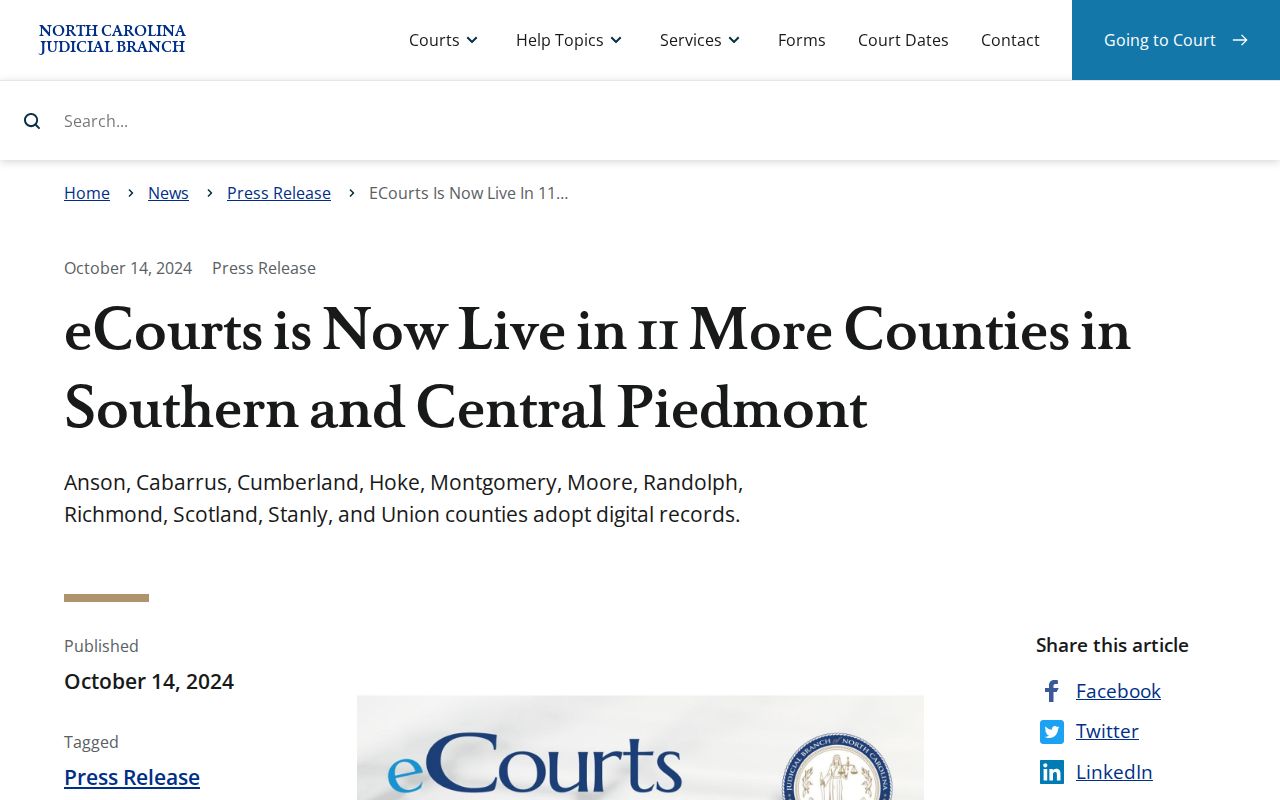
That rollout explains the split a searcher meets today. Current Hoke criminal docket searches run through Portal, while an older number may still call for a trip to the clerk or a public terminal.
Inside a Hoke County Criminal Docket
Portal arranges public Hoke criminal information into a Case Summary. Depending on the case, it can include case and assignment information, public party information, Case Events, hearings, and dispositions or financial information. Not every Hoke result shows the same charge detail, bond detail, attorney field, or document. Restrictions plus redactions still control what appears.
Read the Hoke header first, then the timeline. A case event is an action placed on the chronology. Think of a filing, notice, hearing, order, or disposition. The latest event can supersede an older notice. For confirming what is next, a listed hearing beats an old docket call.
| Case and assignment | Hoke case number, status, court location, and other available assignment information. |
|---|---|
| Party information | Public party information, subject to confidentiality and redaction limits. |
| Case Events | The chronological Hoke Register of Actions entries, read from newest to oldest when checking a change. |
| Hearings | Available court date, time, location, or courtroom information for a setting. |
| Disposition and financials | Outcome and monetary information only when the Case Summary makes those categories applicable and public. |
Hoke Criminal Courts: Superior and District
Hoke criminal dockets follow the state's trial-court split. Felonies belong to Hoke County Superior Court. Most misdemeanors, infractions, traffic matters, and ordinance violations land in Hoke County District Court. Hoke magistrates sit as District Court officials. They handle preliminary criminal functions, some minor pleas, and bail work. One Hoke County Clerk of Superior Court keeps the court files across the whole structure.
| Hoke criminal matter | Usual court path | Search route |
|---|---|---|
| Hoke felony | Superior Court | Portal Smart Search, then Hoke clerk file if needed |
| Hoke misdemeanor, infraction, or traffic | District Court | Portal or Citation Services, then Hoke clerk |
| Preliminary or limited magistrate work | Magistrate within District Court | Portal and the same clerk/courthouse system |
The North Carolina District Court description puts District Court and magistrate functions inside the same trial-court framework.
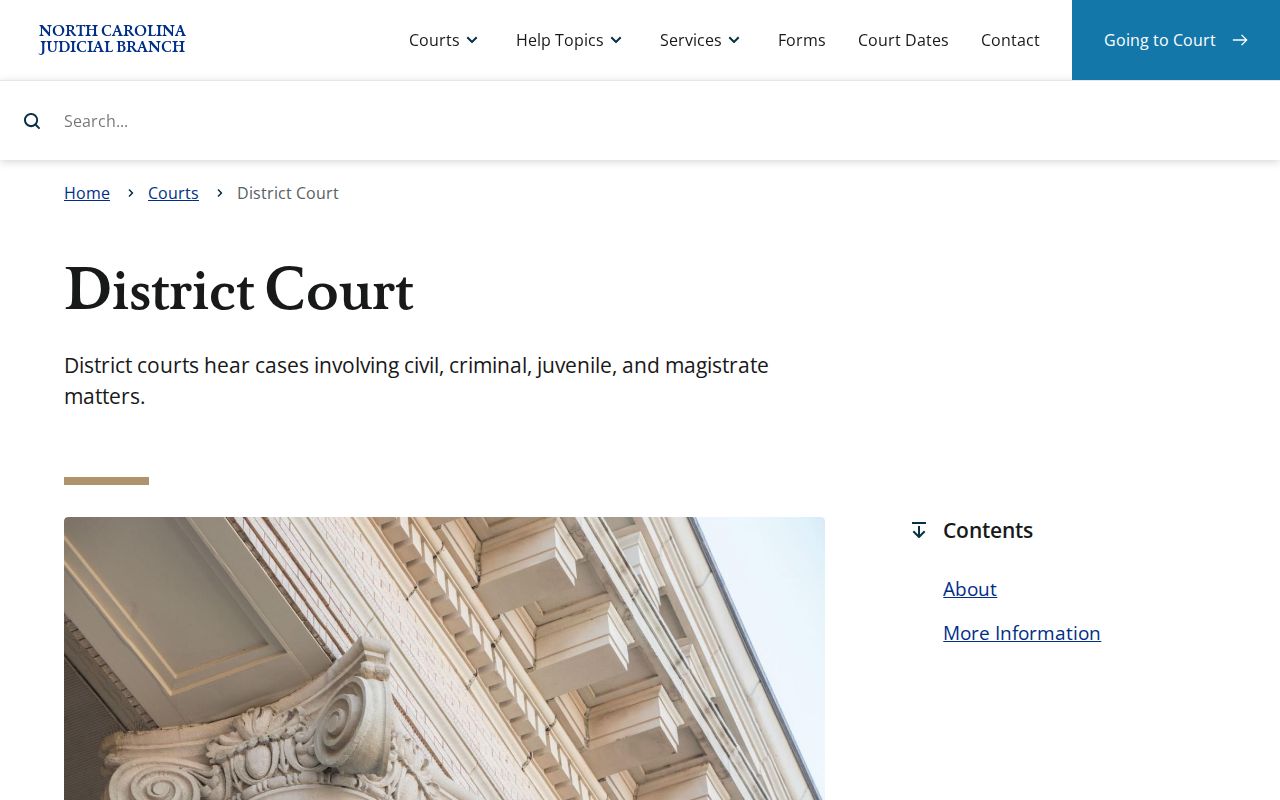
Knowing the court level pays off early. It tells a Hoke criminal docket searcher whether the file is a felony matter or a District Court case before the events are read.
How a Criminal Case Moves
A Hoke criminal docket can show several stages without proving that each occurs in every Hoke case. The usual Hoke procedural path is: filing or charge → arraignment or early appearance → pretrial setting → plea or trial → disposition → sentencing when applicable. Events and hearings are separate Portal categories, so a reader should not mistake a stage label for a confirmed future Hoke date.
A Hoke criminal District Court judgment can be appealed to Superior Court. The appeal brings a new trial there. When that happens, a later Hoke proceeding appears in a different trial division. The practical move is to check the latest case event and hearing information. Then confirm any change with the court when attendance matters. The official Hoke criminal calendar route adds county-filtered calendar context.
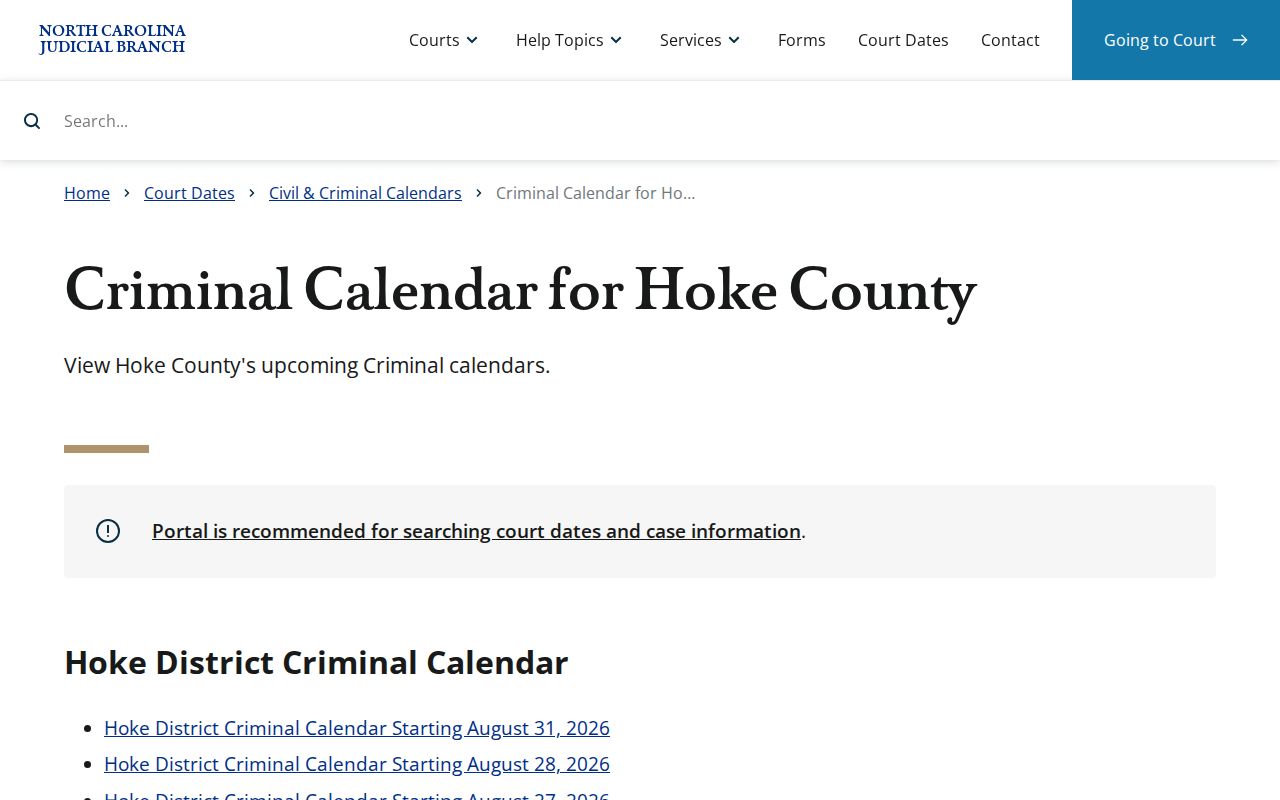
The calendar helps with a session view. For a particular Hoke criminal setting, the individual Case Summary or Search Hearings result is still the better confirmation. Note: a criminal court term or docket call can describe a session without proving that a specific person must appear.
When a Hoke Criminal Hearing Moves
A Hoke criminal hearing that seems to have moved calls for a fresh look. Start with the case's newest Case Events and Hearings. Portal's separate Search Hearings tool searches by case number, party, business, attorney name or bar number, judicial officer, or courtroom. Keep one caution in mind. A prior appearance, continuance, or administrative entry is not necessarily the next setting.
The Hoke calendar hub separates Superior Court criminal sessions from criminal administrative sessions. Those labels describe session structure, not a personal trial date or an individual attendance requirement.
Disagreement between Portal and a calendar is common enough. Call the Hoke County Clerk of Superior Court at (910) 878-4100. Ask for the current date, time, courtroom, and whether attendance is required. The local directory also lists Superior Court Judges at (910) 266-4575. It lists District Court Judges at (910) 722-5012 for division-level scheduling contact.
Courts That Hold Criminal Dockets
Where does a Hoke County criminal docket actually live? Superior Court keeps the felony docket. District Court handles most lower-level criminal matters, infractions, and traffic tickets. The magistrate plays a preliminary role. But that creates no separate Hoke criminal clerk and no separate public docket system. Give the clerk your case number and the court named in the Case Summary. The right file comes up fast.
Hoke County Clerk of Superior Court
304 N. Main St., Raeford, NC 28376
(910) 878-4100
Official file inspection, copies, certification, and public-terminal fallback for Hoke criminal cases.
For a sense of where magistrates sit in the system, the state's small-claims explanation notes that they belong to District Court. Small claims are civil, though. Criminal dockets live elsewhere.
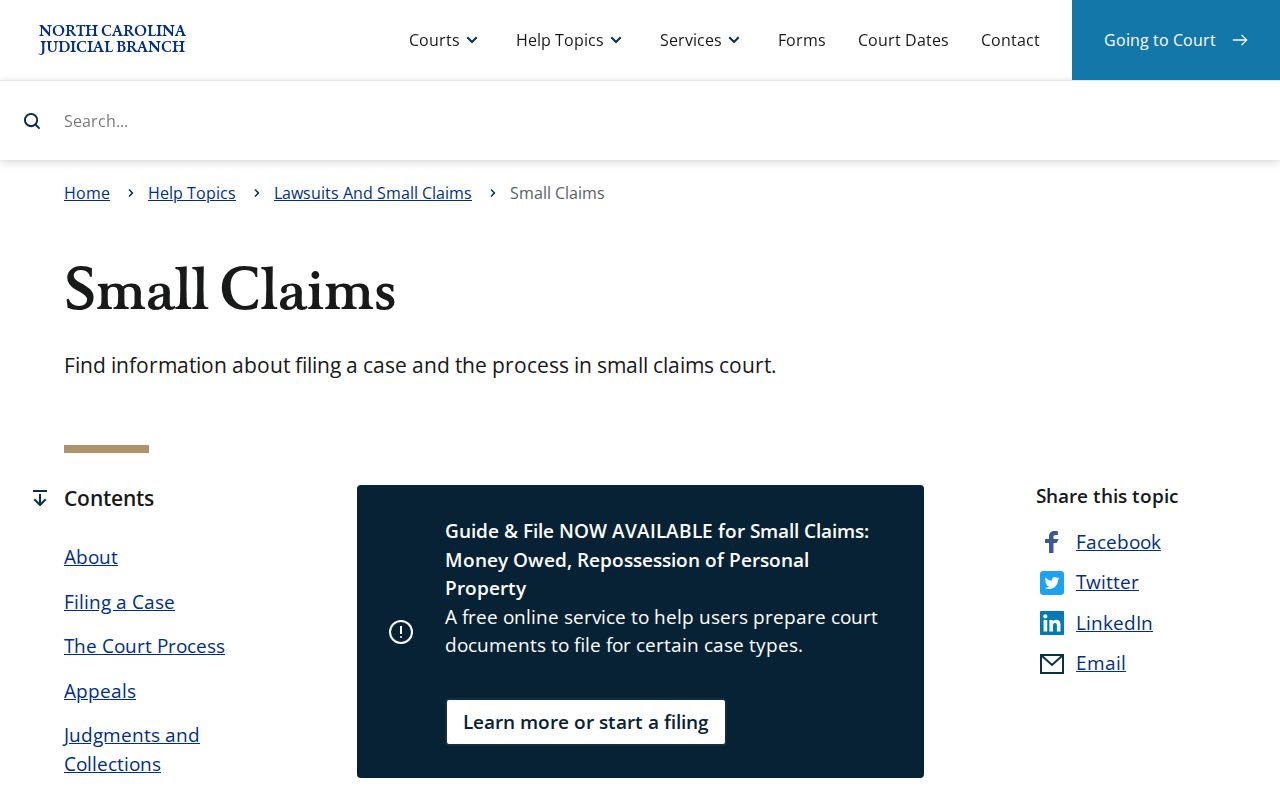
That structure matters for a Hoke County criminal docket search. Even a case that began with a magistrate still runs through the Hoke courthouse clerk. The clerk and the Portal handle it, not a separate county site.
Hoke Criminal Summary or Certified Disposition
A public Hoke Case Summary is handy. It tracks how a case moved through the docket. But it is not the official Hoke court record. When you need an exact outcome, a signed order, or certified proof, ask the Hoke clerk for the right document instead. Give the clerk the Hoke case number, the document type you want, and the rough date. Say whether you need it certified. The clerk posts no Hoke online order form, and no turnaround time is stated.
| Need | Best Hoke route | What it provides |
|---|---|---|
| Follow public events or a setting | Portal Case Summary or Search Hearings | Public case information, not an official record |
| Inspect a public file or older record | Clerk counter or public terminal | Available Hoke court-file access |
| Obtain official proof | Clerk copy and certification request | Prepared copy, certificate under seal, or exemplification as applicable |
What will a copy cost? N.C.G.S. § 7A-308 sets the fees for Hoke court records: $2 for the first prepared page, $0.25 per page after that, $3 for a certificate under seal, and $10 for an exemplification.
Sealed Dockets and Public Access
Not every Hoke criminal record is open just because the Portal is public. Sealed cases, confidential documents, and restricted data simply will not appear there. Juvenile records, unreturned criminal warrants, protective material, and personal identifiers carry extra limits. Having a Portal account changes none of that. When a Hoke County result comes back restricted, the clerk can walk you through what access route exists. The clerk cannot advise you on sealing or expunction.
Hoke criminal access rule: N.C.G.S. § 7A-109 directs clerks to maintain dockets and indexes and generally permits inspection during regular office hours unless law prohibits access.
Chapter 7B, Article 3 supplies special confidentiality rules for juvenile records, while Chapter 15A, Article 5 contains fact-specific expunction routes.
Hoke Criminal Cases Missing Online
A Hoke docket search that comes up empty has several ordinary explanations. The name or number may be off. The case may sit in another county or a different Hoke court level. Or the file may carry a legacy number. A sealed or expunged Hoke record will not show. Some limits on public access apply too. Start by refining the search in the Hoke Portal. If you have a current case number, check the -460 suffix and the Hoke location filter. For a name search, copy the spelling straight from the Hoke court notice.
When the online Hoke route still does not answer the question, go to the public terminal at the Hoke clerk office. Or simply ask the clerk about a paper or archived file. State guidance treats terminals as the on-site fallback for criminal name and case-number searches. The eCourts public-access kiosk guide covers the Portal, File & Serve, printing, and scanning functions as well. Hoke publishes no case-record email, fax, or local online request form. Nothing there replaces a direct Hoke clerk inquiry.
At the courthouse, the Hoke clerk is the practical fallback. Step in whenever the Portal cannot resolve a Hoke record. Bring the Hoke case number or the full case caption. Say which Hoke document or event you need. The clerk can tell you whether a public Hoke file, a terminal search, an archived Hoke record, or a prepared copy is available. The clerk can also separate a true Hoke access limitation from a simple search problem. The clerk does not decide the legal effect of the case.
Note: A missing Portal result does not establish anything. It does not show that a Hoke criminal case never existed. Nor does it fix any particular legal status on the case.