
Searching Hoke County Civil Dockets
The public Hoke online starting point is the North Carolina eCourts Portal. Smart Search reaches Hoke civil actions and nonconfidential special proceedings. Estates and other public Hoke case materials are there too. A Hoke case number is the most direct route. With a name, search broadly first and narrow after results appear. The Portal covers the whole state. Add Hoke location, case type, status, and filing-date filters as needed. A search result opens a Hoke Case Summary or Register of Actions. That is not a certified court record. For a fuller method, the Hoke case lookup route helps, but the Case Summary remains the place to read civil events and hearings.
- Open Portal Smart Search and enter the known Hoke case number or party name.
- Choose Hoke location and narrow by civil case type, status, or filing-date range when needed.
- Open the matching public Hoke Case Summary and confirm the case type, court assignment, and parties.
- Read Hoke Case Events in date order and check Hearings for current setting information.
- Contact the clerk for public file inspection, an older record, or a certified document.
Hoke Civil Dockets by Court Level
Court level is a useful first clue in a Hoke civil docket. Under N.C.G.S. § 7A-243, ordinary civil actions of $25,000 or less belong in Hoke District Court. Above that amount, Hoke Superior Court is the proper division. Both trial divisions hold general concurrent civil jurisdiction under N.C.G.S. § 7A-240. So the Hoke case type and court shown in Portal matter more. Any general label matters less.
| Hoke civil matter | Usual court path | Docket route |
|---|---|---|
| Hoke ordinary civil action at or below $25,000 | District Court | Portal, then Hoke clerk file if needed |
| Hoke ordinary civil action above $25,000 | Superior Court | Portal and Hoke Superior Court calendar context |
| Family matter | District Court | Portal and clerk, subject to access limits |
| Small claim | Magistrate within District Court | Clerk and Portal; confirm Hoke's current limit with the clerk |
| Estate or nonconfidential special proceeding | Clerk of Superior Court | Portal and the Hoke clerk |
Hoke has one Clerk of Superior Court rather than separate civil and probate clerks. That single office keeps the records even though different civil matters travel different court paths.
Inside a Hoke County Civil Docket
Portal presents the public Hoke civil docket as a Case Summary or Register of Actions. It may include Hoke Case Information and Assignment Information. Public Party Information, Causes of Action, and Case Events may appear. Hearings, dispositions, and financial information can show up where applicable. Public Hoke documents may appear too. Still, a document is not guaranteed to be online or free to view or print. Start with the Hoke case type and cause of action. That step separates an ordinary civil case from a family matter, estate, special proceeding, or small claim. Then read the party and assignment information before moving through the events. A filing, service activity, motion, notice, hearing, order, or judgment may show up. Trust only what the actual summary displays.
| Case and assignment | Case number, filing-related information, status, court location, and available assignment details. |
|---|---|
| Parties and roles | Public party information, often showing roles such as plaintiff, petitioner, defendant, or respondent. |
| Cause of action | The category Portal identifies for applicable civil, family, probate, or mental-health matters. |
| Case Events | Chronological public activity, including only filings, notices, orders, and other events actually displayed. |
| Hearings and result | Available setting information and dispositions or financial information when applicable and public. |
Hoke Judgment Search and Case Summaries
NC Judgment Search helps locate an indexed North Carolina judgment. It is not the whole Hoke civil docket. The Hoke index can return a case number and disposition status. Index date and time, parties, and judgment comments may also appear. A result only establishes that a Hoke index item exists. It does not replace the Hoke Case Summary or a certified judgment from the clerk. Use the index result to identify the case. Then return to Smart Search for the public Hoke Case Summary. Compare the case status and Case Events before drawing any conclusion. When the needed item is a signed Hoke judgment or official proof, the clerk is the right channel. That sequence keeps a short index entry from standing in for a complete civil court file.
Civil Case Types on the Docket
The Hoke civil docket spans several record paths. Each can place different information in the Case Summary. The court's classification and cause of action explain what the file concerns. Estate and special-proceeding records belong with the Clerk of Superior Court. Small claims use the magistrate path within District Court. Family matters are District Court matters too, though some information may be restricted.
- Ordinary civil actions, including the civil claims assigned to District or Superior Court.
- Family matters in District Court, subject to the applicable confidentiality rules.
- Small claims before a magistrate within the District Court structure.
- Estates maintained through the Clerk of Superior Court.
- Nonconfidential special proceedings reached through Portal and the clerk.
Case labels make a docket search more precise. Even so, they cannot guarantee that every document or party detail will be available.
Hoke Civil Calendar Requests
The Hoke Civil Superior Court Calendar Request is a scheduling tool for a Superior Court civil matter. It is not a self-service court-date search. The form asks for the file number, parties, requested session beginning, motion or trial type, jury or non-jury choice, estimated time, readiness or conference information, and service certification. Its purpose is to seek placement on a session. To confirm a Hoke date, check the Case Summary's Hearings area or Portal Search Hearings. Then compare against the published calendar. The Hoke civil calendar route supplies county-filtered calendar material, while the case-specific Portal hearing is the better source for one individual setting.
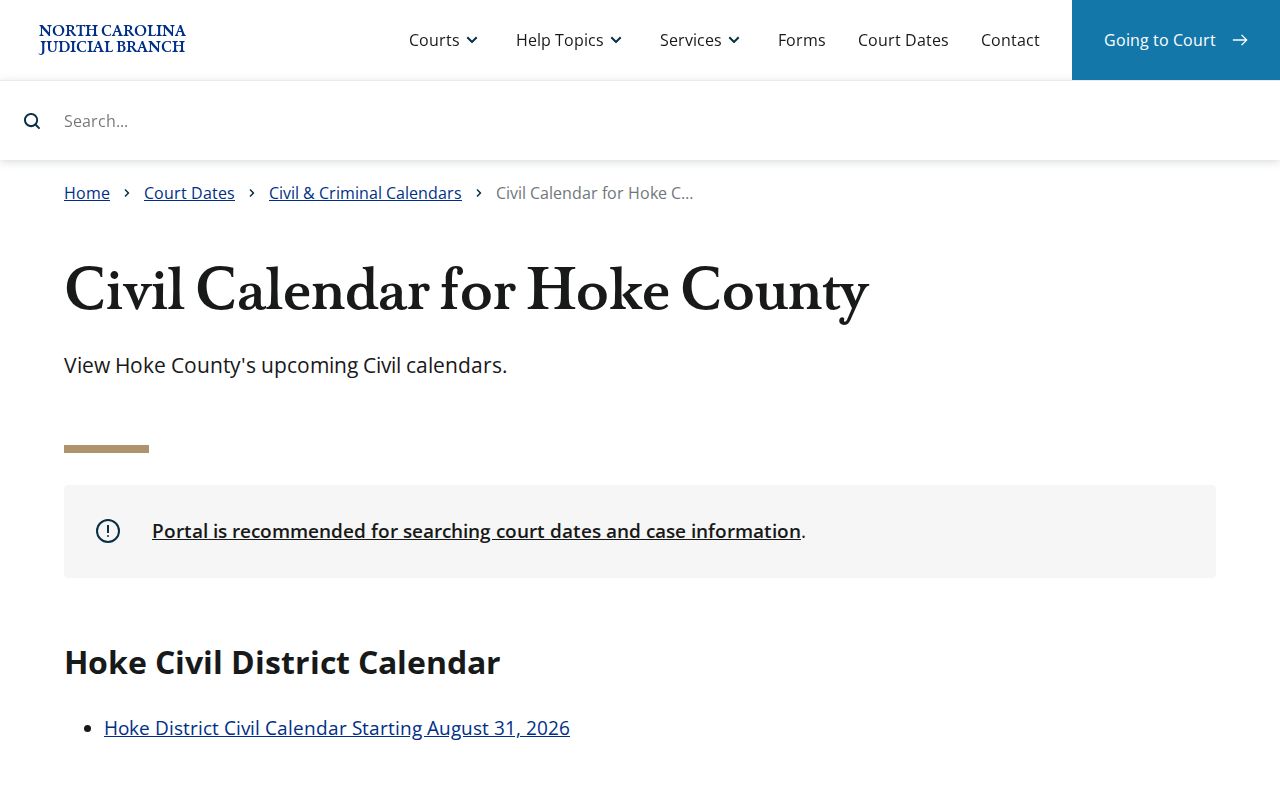
The calendar view can show the wider civil session. It is not proof that a particular Hoke civil case has a hearing at a stated time.
Civil Docket Settings and Hearings
Hoke hearings and Hoke civil terms are not the same thing. A hearing is one scheduled court proceeding. A term or session is a wider block of court time. Hoke's 2026 Superior Court schedule splits its civil settings into two groups. These are motions with jury-trial sessions, and motions with non-jury-trial sessions. Those labels describe how the Hoke session is organized. But for one specific case, the current Hoke hearing listed in Portal is the firmer confirmation.
Also scan the newest Hoke Case Events, not just Hearings. A continuance postpones a matter. A reset replaces an earlier Hoke setting with a later one. The Hoke local rules and forms page carries the local scheduling materials. Those materials include the local continuance policy. That policy makes clear a Hoke civil date does not shift automatically. Just preferring a different time is not enough.
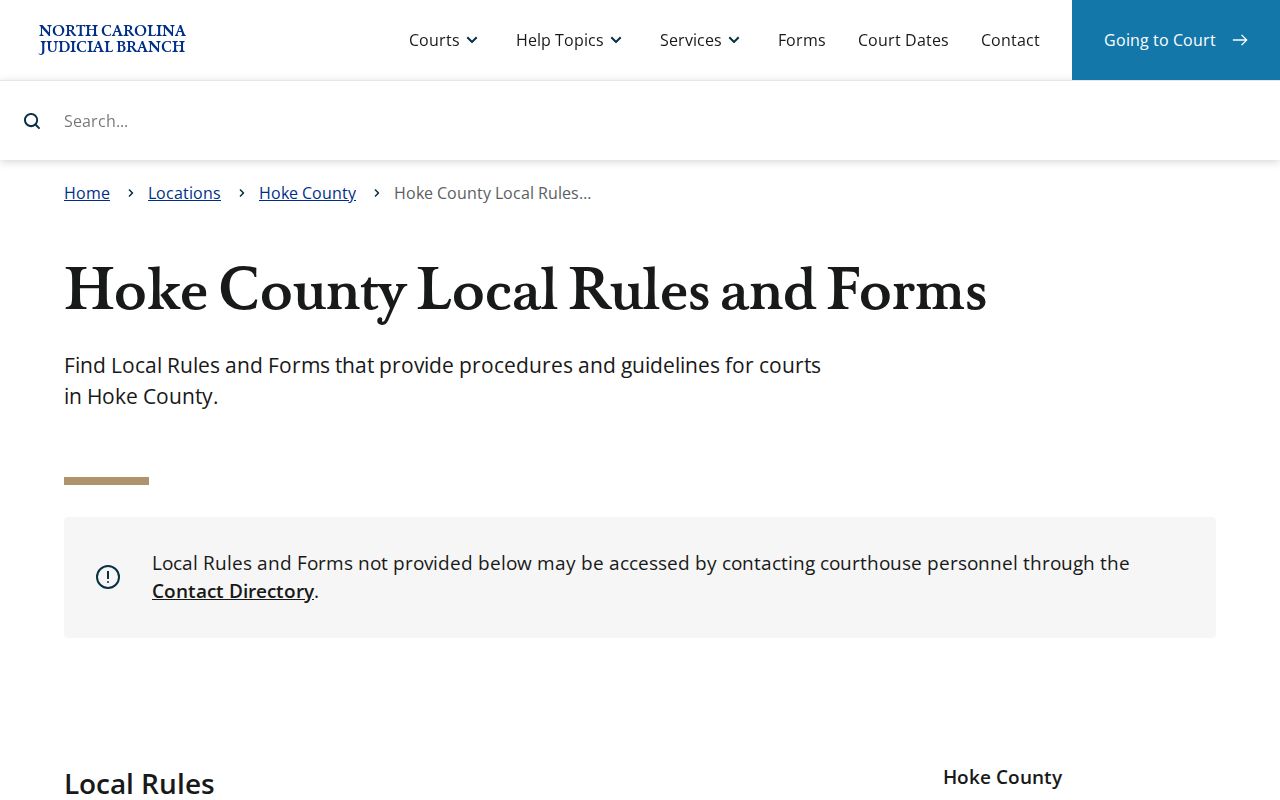
If the Hoke civil calendar and Portal disagree, call the Clerk of Superior Court at (910) 878-4100 to confirm the current case setting and court location. One caution applies. A published civil term is calendar context, not a personal hearing notice and not a substitute for the latest case event.
Hoke Civil Documents Missing Online
A public Hoke Case Summary is an index to the Hoke case. It is not a full document repository. Several things can keep a Hoke document off the public screen. Public access may be limited. Or the document may be sealed or confidential. Viewing or printing may carry a separate fee. Or the Hoke record may need to be consulted through the clerk. An older paper or archived Hoke file can also call for a Hoke clerk inquiry. It will not appear through another Portal filter.
The physical fallback is the Hoke County Clerk of Superior Court. The address is 304 N. Main St., Raeford, NC 28376. Public terminals at the clerk's office support civil, special-proceeding, and estate searches. The clerk can explain available file inspection or copy options. When asking about a document, bring the case number, parties, document type, and approximate date. The clerk's office offers no Hoke case-file email form and posts no local turnaround time.
Filing is a separate track. The North Carolina File & Serve landing page exists for submitting court documents. It is not for searching a public Hoke civil docket. The official page shows its own submission tools.
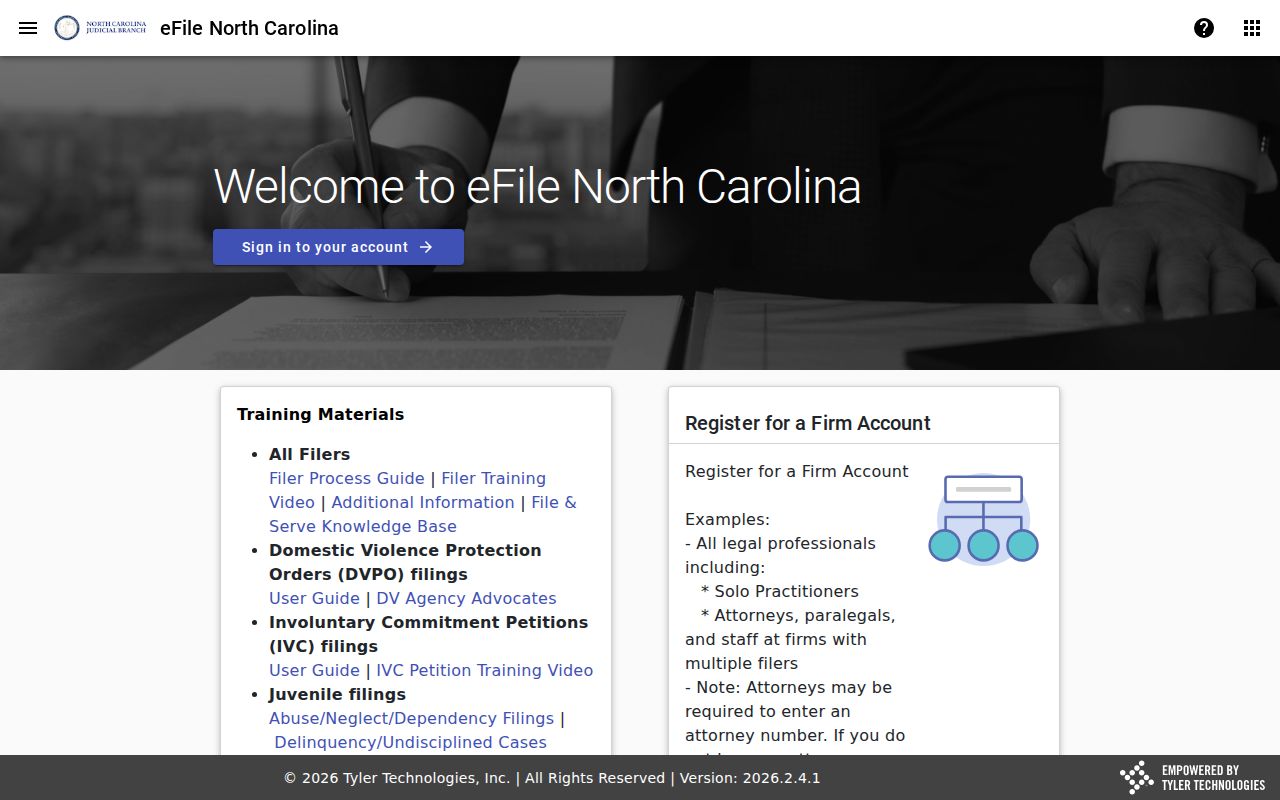
The split matters in practice. Filing a document and viewing the public case chronology are different tasks with different access paths.
Civil Docket Access Rules
Hoke civil dockets are generally open. Access runs through Portal or Hoke clerk-office inspection. But a statute, court order, or confidentiality rule can limit that access. Sealed or confidential Hoke cases, documents, and data stay out of the public Portal. Hoke family and other sensitive matters may carry special restrictions. A public Portal account unlocks nothing the law keeps closed.
Public inspection and copies: N.C.G.S. § 7A-109 requires clerks to maintain dockets and indexes and generally permits public inspection during regular office hours unless law forbids it.
N.C.G.S. § 7A-308 sets $2 for the first prepared copy page, $0.25 for each additional page, $3 for a certificate under seal, and $10 for an exemplification where needed.
Hoke Civil Court and Deed Records
A Hoke court case touching real property is not the same as a deed. The Hoke clerk holds the Hoke court records. They are tied to foreclosures, evictions, partitions, condemnations, estates, divorces, judgments, and liens. You can locate those matters through a Hoke civil Case Summary. Or use the Hoke clerk's file route. The Hoke deed itself sits with the Register of Deeds, not the Hoke court docket.
That boundary saves a wrong-office search. Someone chasing a Hoke civil foreclosure case, Hoke judgment, or Hoke estate proceeding should start with Portal. The Hoke clerk works too. Someone who needs the recorded Hoke deed should go through the Register of Deeds channel. For an official Hoke court document, ask the clerk a simple question. Does a prepared copy, a certificate under seal, or an exemplification fit the request?